


Sapere aude—dare to know.
There is something bracing about a modern debate in an old college hall. Students and professors showing off their knowledge of language and the issues—usually political ones. One recent Thursday evening the auditorium at Suffolk Hall at Winthrop College was filled to capacity. This time it was two senior professors debating. The theology students had come early. The business majors late. The donors arrived right on time and sat in the middle, where history tends to unfold most comfortably.
A banner hung above the stage:
THE CHARTER OAK DEBATES
Modern American Religion Is Abandoning Metaphysics
The moderator—a political science professor who described himself as “spiritually adjacent”—welcomed everyone and reminded the audience that applause was permitted, but exorcisms were not.
At stage right stood Dr. Jesse Petersen, professor of systematic theology. At stage left, Dr. Daniel Harris, philosopher of science and professional dismantler of sacred cows.
Opening Statements
“Let me reassure everyone,” Dr. Harris began, “I am not here to abolish religion. That department has its own committees.”
Nervous laughter and more coughing and settling in.
“For centuries, Christianity made robust claims about reality. God exists. Truth is objective. Moral law binds all persons. These were not culture-war slogans. They were ontological commitments.”
She paused.
“My claim tonight is not that Christianity is false. My claim is that a significant strand of modern American religion is abandoning metaphysics in favor of narrative sovereignty.”
She defined the phrase carefully.
“Narrative sovereignty is the belief that controlling the story—legally, culturally, politically, rhetorically—is equivalent to securing the truth.”
She continued:
“When pastors declare from pulpits that America is a Christian nation not as a theological aspiration but as an unquestionable historical fact, or when institutional leaders argue that demographic or cultural majority proves moral legitimacy, we are no longer debating metaphysics.”
“The focus shifts from ‘Is it true?’ to ‘Will it win?’”
A burst of applause.
“When repetition becomes proof,” Harris concluded, “we have left the Summa Theologica and entered the algorithm.”
A few laughs, but not from the techies.
Dr. Petersen stood.
“I appreciate the algorithm reference,” he said. “The angels are still debating whether it is big enough to dance on it.”
A few in the room relaxed.
“But religion has always cared about civilization,” he continued. “Augustine wrote about cities. Aquinas advised princes. The church has never been allergic to power.”
He allowed a small smile on his face, as though he had practiced it.
“If religion avoided politics entirely, it would own fewer stocks and even fewer souls.”
Laughter—donors included.
“When religious leaders defend traditional moral claims in the public square, they may do so clumsily. But engagement does not equal abandonment.”
He raised a finger.
“Christians still claim moral truth is objective. They still affirm that God transcends the state. They still insist that reality is not manufactured by majority vote.”
He concluded:
“Hypocrisy, if present, is a moral failure. It is not proof that metaphysics has packed its bags and headed to Las Vegas.”
Second Round
Dr. Harris softened his tone this time.
“If metaphysics remains intact,” he asked, “why is this distortion increasingly acceptable?”
The question lingered.
“When pastors excuse dishonesty because it protects the unborn or when institutions justify misleading claims because they defend religious liberty—or, how about this, when civilizational rhetoric flirts with racial hierarchy under the banner of heritage . . .”
The air thickened.
“Truth becomes instrumental. It becomes valuable insofar as it serves the cause.”
He lowered his voice.
“Let’s be honest and question whether the American right today is interested in the truth. In metaphysics, truth is sacred because it corresponds to reality. In post-truth religion, truth is sacred because it secures survival.”
A silence.
“That is the shift.”
Dr. Petersen rose without humor now.
“My colleague is right about one thing,” he began. “There are pastors who speak too confidently about history. There are institutions that lean too eagerly into civilizational rhetoric. And there are believers who excuse what should not be excused. Any time on YouTube will reveal that.”
He did not rush.
“But let us examine the evidence more broadly.”
He ticked off examples without looking at notes.
“There are evangelical seminaries where evolutionary biology is openly taught and debated, not feared. There are Christian bioethicists engaging CRISPR and AI with metaphysical seriousness. There are theologians publishing on natural law in dialogue with secular philosophers. There are churches defending religious liberty not to dominate, but to preserve pluralism.”
A few heads nodded. Then even some claps.
“There are believers who opposed political falsehoods even when it cost them congregants. There are denominations splitting precisely because some refused to instrumentalize truth. There are Christian legal scholars defending constitutional limits on their own power.”
He paused.
“These are not the actions of a movement that has abandoned metaphysics. These are the growing pains of a tradition wrestling with modernity.”
“Exactly,” interrupted Dr. Harris.
“Please, it’s my turn.” His voice steadied further.
“If some religious leaders treat power as validation, they are not expressing Christian metaphysics. They are betraying it. The metaphysical claim remains: truth is grounded in reality, not in dominance.”
He leaned slightly forward.
“The cure,” he added, “is not to abandon religion but to return to its claim that truth answers to something beyond us.”
Closing Statements
Eventually, the debate wound toward an end.
“I’m afraid Dr. Petersen has been left behind. Modern American religion stands at a pivotal moment,” Dr. Harris said.
“It can double down on narrative sovereignty—believing that institutional strength secures moral truth. Or it can return to metaphysical seriousness—risking marginalization in a pluralistic age.”
He now smiled.
“If God is real, He does not need narrative reinforcement. If truth is objective, it does not require strategic editing.”
His final line:
“The tragedy would not be that religion is wrong. The tragedy would be that it stopped caring whether it is.”
Dr. Petersen rose slowly, folded his notes. He seemed less defensive now, more from the heart.
“If some religious leaders—as we have seen today—treat power as validation, they are not expressing Christian metaphysics. They are betraying it. The metaphysical claim remains: truth is grounded in reality, not in dominance.”
He leaned slightly forward.
“The danger is real. But so is the corrective.”
Silence.
“Religion does not become postmodern because some believers confuse victory with truth. It becomes postmodern only if it decides that victory equals truth.”
He allowed the words to settle.
“And if that day comes—I will consent to Dr. Harris—if Christians truly believe that reality bends to repetition, then they will have disproven their own doctrine. Which would be a remarkably metaphysical way to lose a culture war.”
He gave a faint smile. “I don’t think that is the case today.“
“A tradition does not cease to be metaphysical because some of its adherents behave tribally. By that measure, every university, newsroom, and political party in America would have surrendered epistemology long ago.”
Some cheers.
“The question is not whether religious people are tempted by narrative power. Of course they are. The question is whether their central claims still assert a reality that does not bend to their will.”
He paused deliberately.
“Christian metaphysics says this: if we lie, reality does not adjust. If we distort, God does not revise Himself. If we repeat a claim loudly enough, it does not become true.”
He looked across the room.
“I’m aware that this is the view of the President of the United States. And I’m aware that many of his supporters are religious. The claim about truth may be ignored. It may be betrayed. But it remains.”
The final line came, dry and precise:
“If narrative sovereignty truly governed Christianity, we would have edited “sin” out centuries ago.”
A hush.
“But we didn’t.”
Silence — then sustained applause.
Dr. Harris won the debate based on a vote before and after. But, characteristically, reality did not vote.
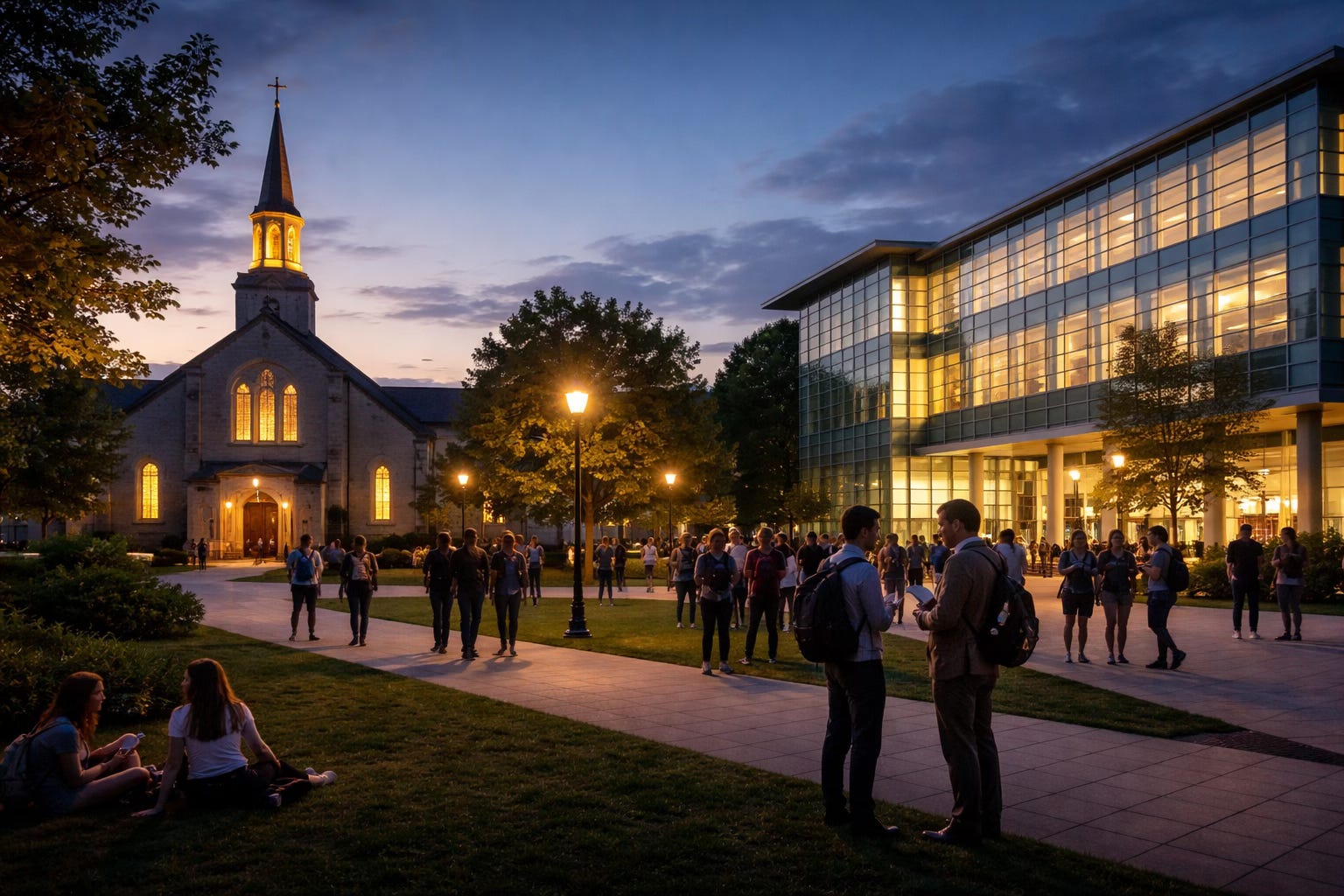
Outside, the quad hummed with talk of nightlife and ontology. One journalist for the school paper was drafting an op-ed in his head. A theology professor quietly texted some lines to himself.
The bells of the campus chapel rang on schedule.
Across the lawn, the glass and steel biology building stood somewhat out of place in this old college, and perhaps a bit defiantly.
Neither building adjusted its position.