


The café was one of those modern places that had been designed by someone who thought curtains came from the lower regions. There was a concrete floor with hanging plants like your sterile tech-friendly roommate wants. Outside, rain caused the street some philosophical reflection.
Milo arrived first. Readers will already know he is handsome in a way that suggests both vanity and sorrow. Since the breakup, he had been dressing better. It’s one of the oldest male rituals—losing love and buying a jacket.
Adrian was ten minutes late, which for him meant exactly on time according to a private system no one else understood. He entered carrying two books, a thermos, and an expression which already disagreed with three strangers internally.
“You look thinner,” said Adrian.
“You look diagnosed,” said Milo.
They embraced.
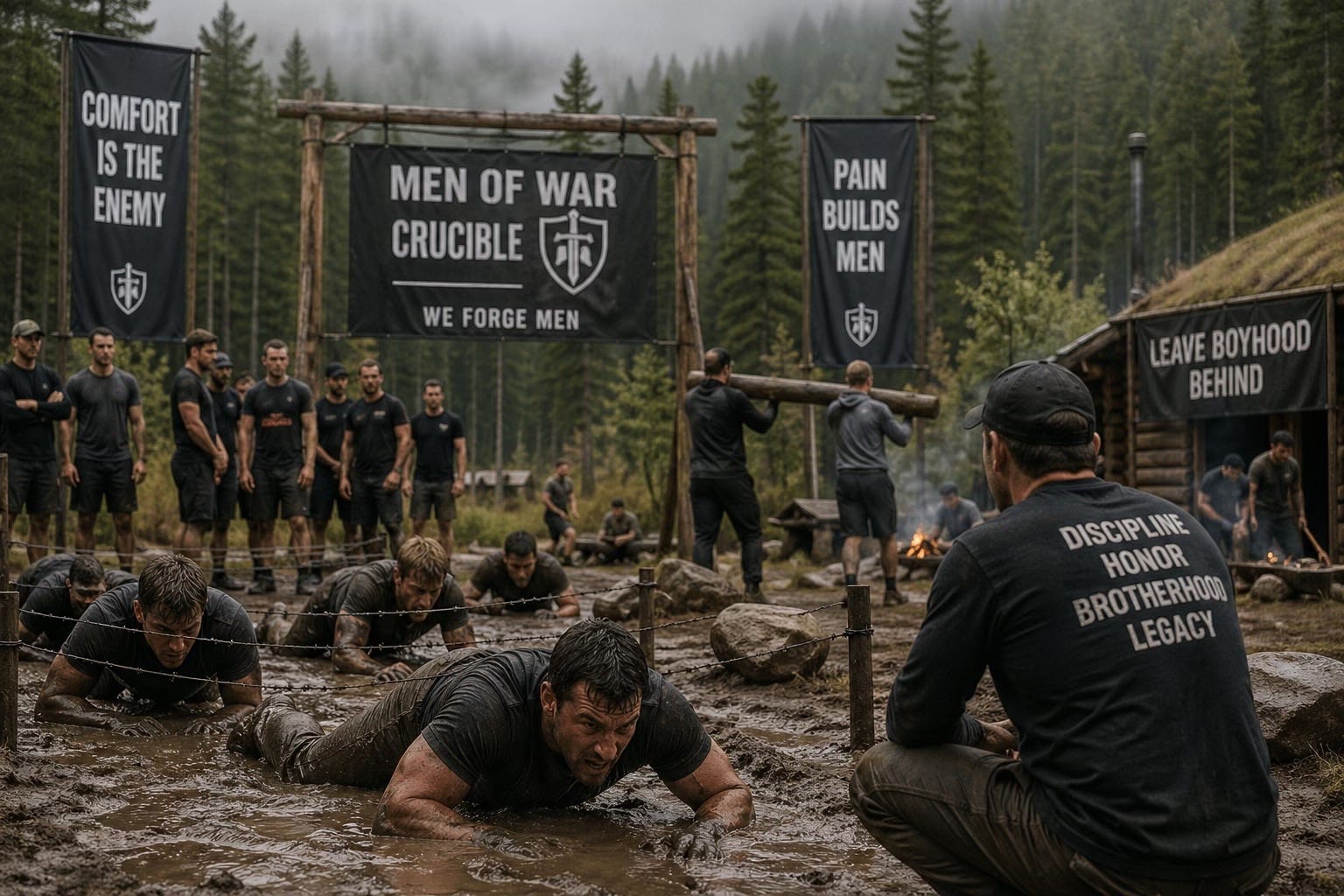
Milo slid some printed material across the table. “The New Yorker article on masculinity camps I told you about. Men crawling through mud and carrying rocks of shame. Fathers paying nine hundred dollars so their sons can be yelled at by someone else.”
“I read it.” Adrian still scanned the material. “Ritualized suffering with premium pricing,” he mused.
“They call it becoming alpha.”
“Nothing says alpha like trying to fit in.”
“Haha. Liberals mock this,” said Milo. “But what if the right wingers are responding to something real? What if they are actually having a masculinity crisis?”
Adrian removed his glasses and cleaned them with the grave tenderness of a man resetting civilization.
“Pain can be real,” he said. “The explanation of pain is often stupid.”
“That’s very you.”
“It’s probably why I remain unmarried.”
Milo leaned back. “Look, progressive men like us—”
“Speak for yourself politically.”
“You vote left.”
“I vote against embarrassment, wherever that might come from.”
“Fine. Men like us. We don’t sit around worrying if we’re man enough. We have careers, books, music, therapy, opinions about a recent film. Have you seen Michael? It’s better than I thought it might be. Anyway, maybe masculinity matters less once you have other identities.”
Adrian nodded slowly skipping the reference to the weekend’s new “it” movie. “There’s something in that. If you can say ‘I am a composer,’ ‘I am a scientist,’ ‘I am a teacher,’ ‘I am a person who bakes superior focaccia,’ then ‘I am a man’ doesn’t need to carry that whole burden . . . of what . . . that whole burden of selfhood. It’s actually the Right who has become obsessed with gender. They’re panicking that it didn’t mean what they thought it did. It’s been tied up with a lot of other things for them. For one, power in their country.”
“Exactly.”
“But.”
“There’s always a but with you.”
“But group identities do not disappear just because educated people get bored with them. They remain powerful where work is more physical, where communities are tighter, where symbolic language matters more.”
Milo stirred his coffee. “So the electrician gets masculinity where the curator gets taste.”
“Mmmm. Crude, but yes.” Adrian turned back to the article.
“These camps fascinate me less as politics than as unmet need. Look—grief, loneliness, no close friends, fathers wanting to do better than their fathers, men unable to speak until someone hands them a sandbag and shouts nearby. It’s just everyday pain. There’s nothing new here.”
“You sound sympathetic.”
“I am sympathetic. I am not sympathetic to the branding. Alpha. Beta. Sovereign male. This is a new marketer’s naming for the soul.”
Milo stared out the window. “My cousin went to one of these things,” he said.
Adrian looked up. “You never mentioned him.”
“I don’t mention him because he thinks I’m what happened to America.”
“Family!”
“He works in HVAC outside Boise. He’s a good guy. Reliable. Coaches Little League. But after his divorce he got deep into podcasts. Telling me things like ‘modern men have been neutered by comfort.’ He went to a weekend retreat. Came back talking about discipline, brotherhood, cold plunges, and not apologizing.”
“Did it help?”
Milo paused.
“For six months, yes. He quit drinking. If that is good. . . . lost some weight. Talked to his wife more. Then he started posting shirtless advice videos with captions like PAIN is the RENT for GREATNESS.”
Adrian winced. “Recovery often takes a theatrical phase.”
“You joke, I think he was hungry for something else.”
Outside, a cyclist in yellow glided through the rain like a banana.
Adrian spoke more softly now.
“Modern life stripped many rites of passage. No village notices that you are becoming a man. No elder names your strengths. No task proves anything except that you can do payroll. So people are buying a script.”
Milo blinked. “That’s almost beautiful, man.”
“I’m capable of accidental beauty.”
“Haha. So are progressive men missing something?”
Adrian considered.
“Yes and no.”
“Not a promising answer.”
“We are right to reject domination, emotional illiteracy, cruelty disguised as stoicism, the cult of never apologizing. But in rejecting bad masculinity, some men reject any aspirational masculinity at all.”
“Aspirational masculinity. Meaning?”
“Strength in service. Competence under pressure. Protection without possessiveness. Humor in hardship. Responsibility freely chosen. Loyalty. The ability to build and endure.”
Milo smiled. “You’ve been reading the Romans again.”
“I contain multitudes . . and their footnotes.”
Milo’s face changed then, some shadow returning. “When my ex left,” he said quietly, “I realized how much of my confidence was relational. I thought I was this evolved modern man beyond gender scripts. Then suddenly I wanted absurd things.”
“What things?”
“To fix shelves. To grow a beard. To be called dependable. To carry groceries into the house in one trip.”
Adrian nodded as if hearing lab results. “A breakup often reveals hidden metaphysics.”
“I’m serious.”
“So am I.”
Milo laughed despite himself. “I wanted to feel… solid.”
“Bodies matter. Social expectations matter. Boys are treated in certain ways. Men are invited and punished in certain ways. Gender is not fiction, only badly written when turned into a slogan.”
Milo pointed at him. “That should be on your tombstone.”
Adrian ignored this. “You once told me I seem autistic.”
“I said spectrum-adjacent.”
“Which is now how baristas describe everyone who alphabetizes their drinks.”
Milo grinned. “Fair. Do you do that?”
Adrian folded his hands. “I never understood masculinity as a tribe. I understand it as a performance I might be failing. Other boys grasped rules intuitively—banter, ranking, aggression turned up just so. I learned these things analytically, late, and with poor user experience.”
Milo stared. “You’ve never said that.”
“No one asked.”
“And now?”
“Now I think many so-called masculine traits are simply human capacities coded male by hindsight. Directness. Courage. Technical obsession. Protective instinct. Emotional reserve. Some healthy, some unhealthy, all contingent.”
“But about the actual biology?
Adrian shrugged.
“Biology matters, certainly. Strength matters. Sex differences matter. Hormones matter. But biology gives tendencies, not a dress code. It can explain why men are, on average, larger than women. It cannot explain why a real man must grill outdoors, fear therapy, or own three identical pickup trucks. Nature loads the gun and culture fires it.”
So you don’t feel outside masculinity?”
“I feel outside marketing.”
They both laughed.
A server arrived with pastries no one had ordered. This was the sort of place that occasionally gifted fennel.
Milo tore off a piece.
“So what do we do with men who say they’re in crisis?”
“We believe the suffering without automatically believing the ideology.”
“That’s pretty good. Your responses are always so glib. You’re a typical materialist. You know, that’s why they hated Obama.”
“Speaking about masculinity. So, how about better rituals?”
“Such as?”
“Mentorship. Team sports without humiliation. Trade apprenticeships. Men’s groups without cosplay. Art. Service projects. Community choirs. Milo nearly spit out coffee.
“Community choirs as masculinity intervention.”
“Yes. Nothing is more secure than singing tenor in Bach’s St. Matthew’s Passion beside strangers.”
This led to companionable silence.
Finally Milo said, “Do you think conservatives are just clinging to old forms while progressives embrace change? You know . . . the old story?”
Adrian shrugged. “Sometimes. But sometimes conservatives preserve goods progressives neglect, and progressives liberate people from goods that had become cages. Politics is often a two error-correcting system that often insults each other.”
“That may be your most centrist statement.”
“It’s not centrist. It’s tragic.”
The rain came down heavier on the window. Milo gathered the article.
“So no alpha camp for us?”
Adrian stood, adjusting his coat. “My dear Milo, we are going to rehearsal, then to dinner where we will discuss literature and later flirt badly with whoever is there.”
“That’s your model of masculinity?”
“That’s my model of civilization.”